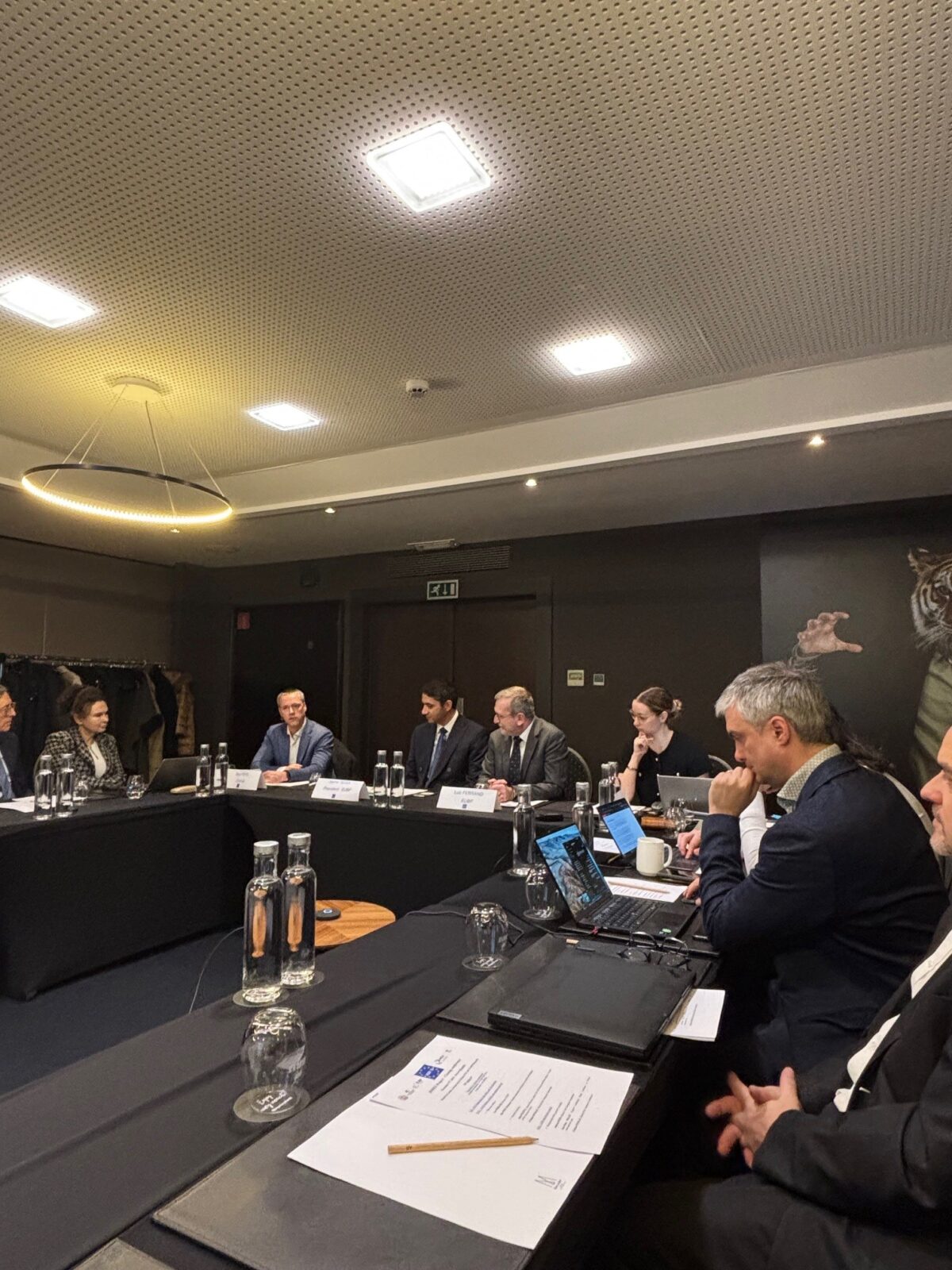

On 17 December 2025, the Closing Conference of the JODES project, a project co-funded by the European Commission, was held in Brussels at the Hôtel Le Louise. The event brought together numerous institutional stakeholders, technical experts and practitioners of European judicial cooperation to take stock of a major project in the field of digital justice.
On this occasion, the European Union of Judicial Officers (UEHJ) was represented online by Ilias Tsipos, Vice-President. The International Union of Judicial Officers (UIHJ) was represented by Patrick Gielen, Secretary General, as well as by Carlos Calvo, Treasurer of the UIHJ.
The conference opened with welcoming remarks by Luc Ferrand, Director of the EUBF, and Bas Feys, Treasurer of the National Chamber of Judicial Officers of Belgium. The opening speeches were then delivered by Alain Pilette, Deputy Director for Justice at the Justice and Home Affairs Directorate of the Council of the European Union, and Cristian Nicolau, Head of Unit at the European Commission. These interventions highlighted the strategic importance of the JODES project for the development of a modern European judicial cooperation framework based on secure and interoperable digital tools.
During the introductory session, Andreas Stein, Head of Unit at the European Commission, presented Regulation (EU) 2020/1784. He underlined its objective to modernize and speed up the cross-border service of documents in civil and commercial matters, notably using secure digital tools and e-CODEX, in line with the approach and outcomes of the JODES project.
The subsequent sessions revisited the origins of the project and provided a detailed explanation of the technical implementation of JODES. The speakers presented what had initially been planned, the solutions that were developed, and the technical choices made to ensure interoperability between national systems. Attention was paid to the integration of the project within the existing European ecosystem, notably using the e-CODEX framework, a key element for the secure and standardized transmission of cross-border judicial communications.
In this context, the role of European actors specializing in digital justice infrastructures, such as eu-LISA, was highlighted as being essential to the sustainability and further development of these solutions.
The presentation of the project’s results then focused on the operational tools and training activities developed for the benefit of practitioners. A video demonstration of the JUDEX platform was presented by Patrick Gielen and Carlos Calvo, clearly illustrating the functionalities implemented within the framework of JODES and their contribution to more efficient, faster and more secure cross-border judicial cooperation.
Through their involvement in the JODES project, the UEHJ and the UIHJ reaffirmed their shared commitment to innovation, the digitalization of justice and the strengthening of European judicial cooperation, in line with European standards and in the service of effective access to justice for both citizens and professionals.