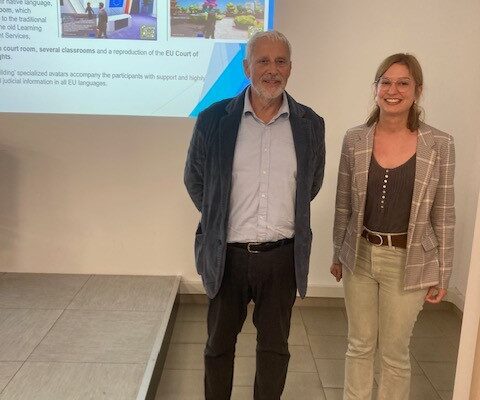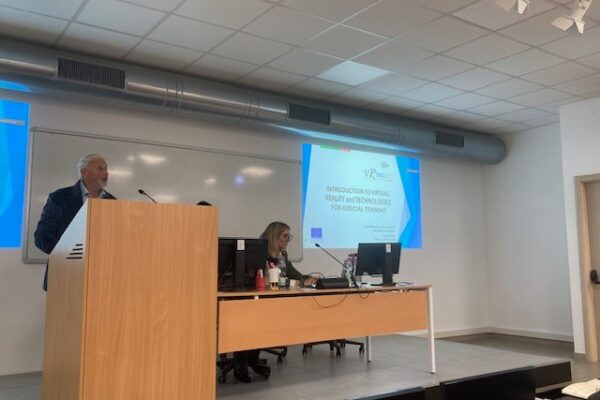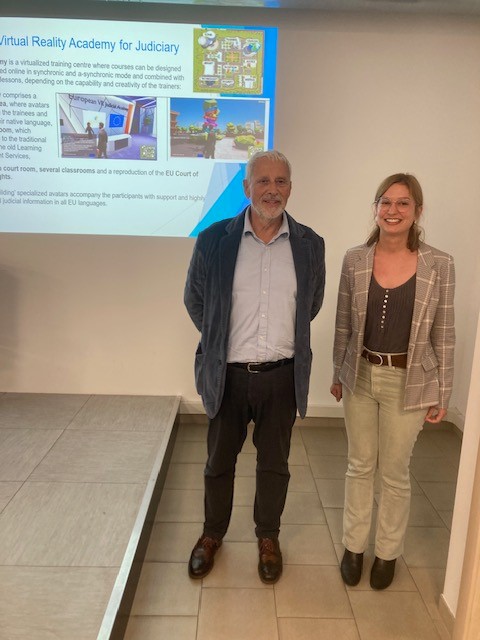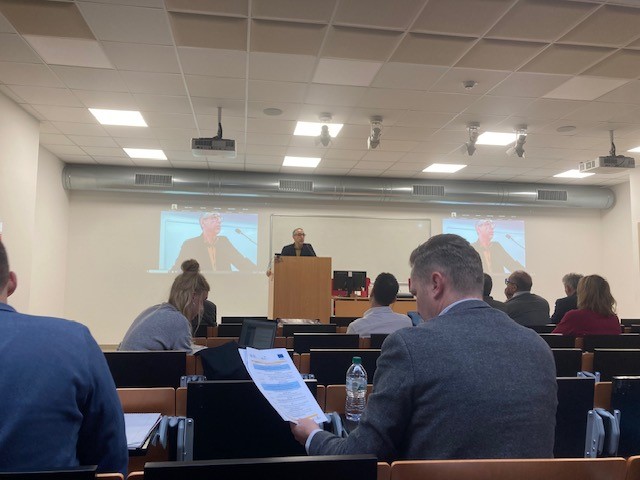

On 21–22 October 2025, the closing conference of the EU-co-funded VR-DigiJust project, titled “Justice and Artificial Intelligence: Rights, Responsibilities, and Skills in the New Digital Era,” was held in Venice. The International Union of Judicial Officers was represented by Charlotte Choquet, expert member and candidate judicial officer in Belgium.
Day one featured the presentation and live demonstration of the VR-DIGIJUST platform, developed by Agenfor International. Its director, Mr. Sergio Bianchi, outlined the risks associated with artificial intelligence and stressed the need to provide verified information. Designed as a game-like environment, the platform lets users move through digital spaces—a reception area, a library, classrooms, a courtroom, and even the European Court of Human Rights. The library hosts legal documents, slide decks, and videos with carefully verified sources, while the courtroom allows simulated hearings.
The training potential is significant. Users can interact with avatar-assistants that respond in multiple languages. During the workshop, participants tested the platform through a fictional human-trafficking case, gathering evidence and identifying the elements necessary to advance the procedure.
Day two focused on AI-related risks and the protection of fundamental rights. Topics included the use of videoconferencing tools in hearings (presented by Mrs. Giovanni Canzio, Honorary President of the Italian Court of Cassation), risks in legal translation (by Mr. Sami Kodia, judicial expert at the Court of Appeal of Douai, France), solutions to ethical issues for programmers, and the dangers of predictive justice (by Mr. Frederic Cappelletti, lawyer and Co-President of the Observatory on European Law of the Union of Italian Criminal Chambers). A clear consensus emerged: decision-making must remain with the judge.
Speakers also examined AI bias and discussed the recent case of Raine v. OpenAI. As Mrs. Sarah Holland-Kunkel, researcher and professor of fundamental rights, noted, failures can be striking—for example, an AI that “sees” a wolf in a photo of a husky simply because snow is present.
Regulating AI use and ensuring respect for fundamental rights, the right to a fair trial, the presumption of innocence, privacy, and non-discrimination, are therefore essential. The conference highlighted key issues of this new AI era and showcased current European legislation and initiatives. States will need to keep pace with these developments, and so will Judicial Officers, who remain pillars of the right to a fair trial.