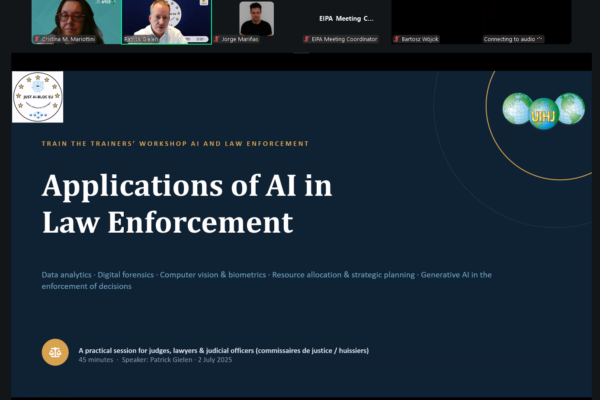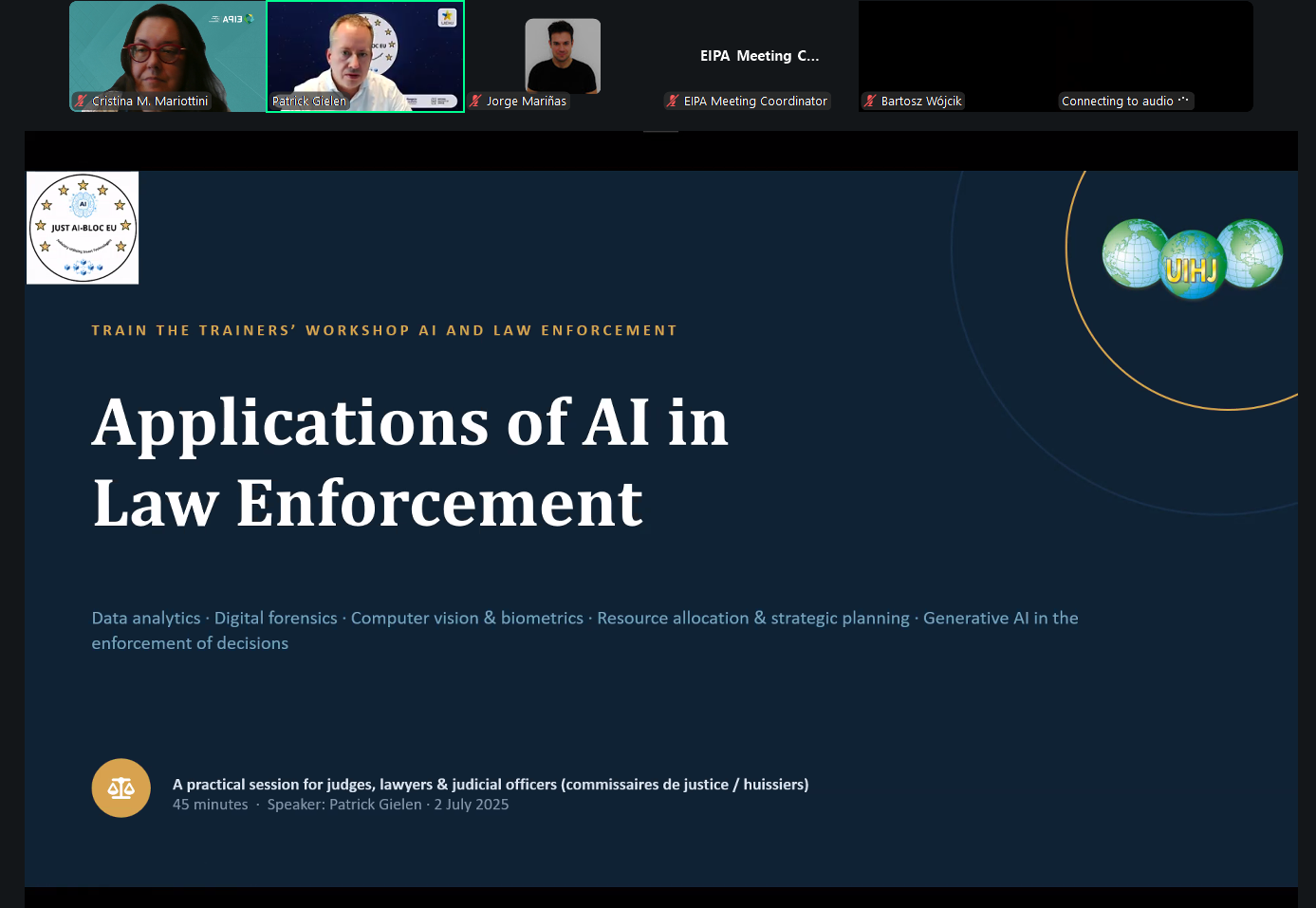

The UEHJ, partner in the JUST AI-BLOC EU project managed by EIPA Luxembourg, European Centre for Judges and Lawyers, took part in the second Train the Trainers workshop, which was held online on 2 July 2026. More than one hundred participants, judges, lawyers and judicial officers from all over Europe, attended this training day.
The JUST AI-BLOC EU project, entitled “Judiciary Utilising Smart Technologies: AI and Blockchain for Optimised Compliance in the EU” and co-funded by the European Union, aims to strengthen the capacity of judges, prosecutors, lawyers and judicial officers across the European Union to navigate artificial intelligence and blockchain technology in the justice sector. It runs over two years through legal English seminars, Train the Trainers workshops and interprofessional regional conferences.
The morning was opened by Dr Cristina M. Mariottini of EIPA, who presented the regulatory framework established by the EU Artificial Intelligence Act, its objectives, the prohibited practices, high-risk systems and innovation mechanisms such as regulatory sandboxes.
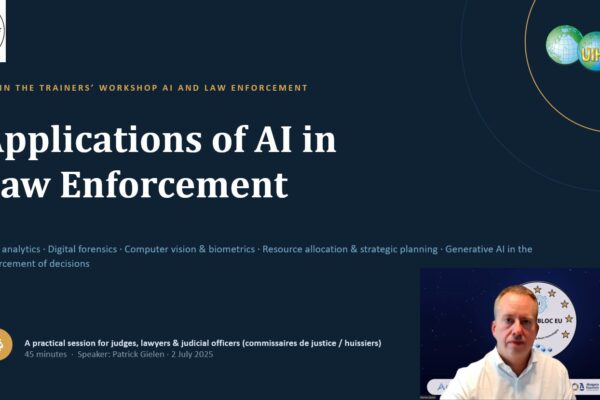
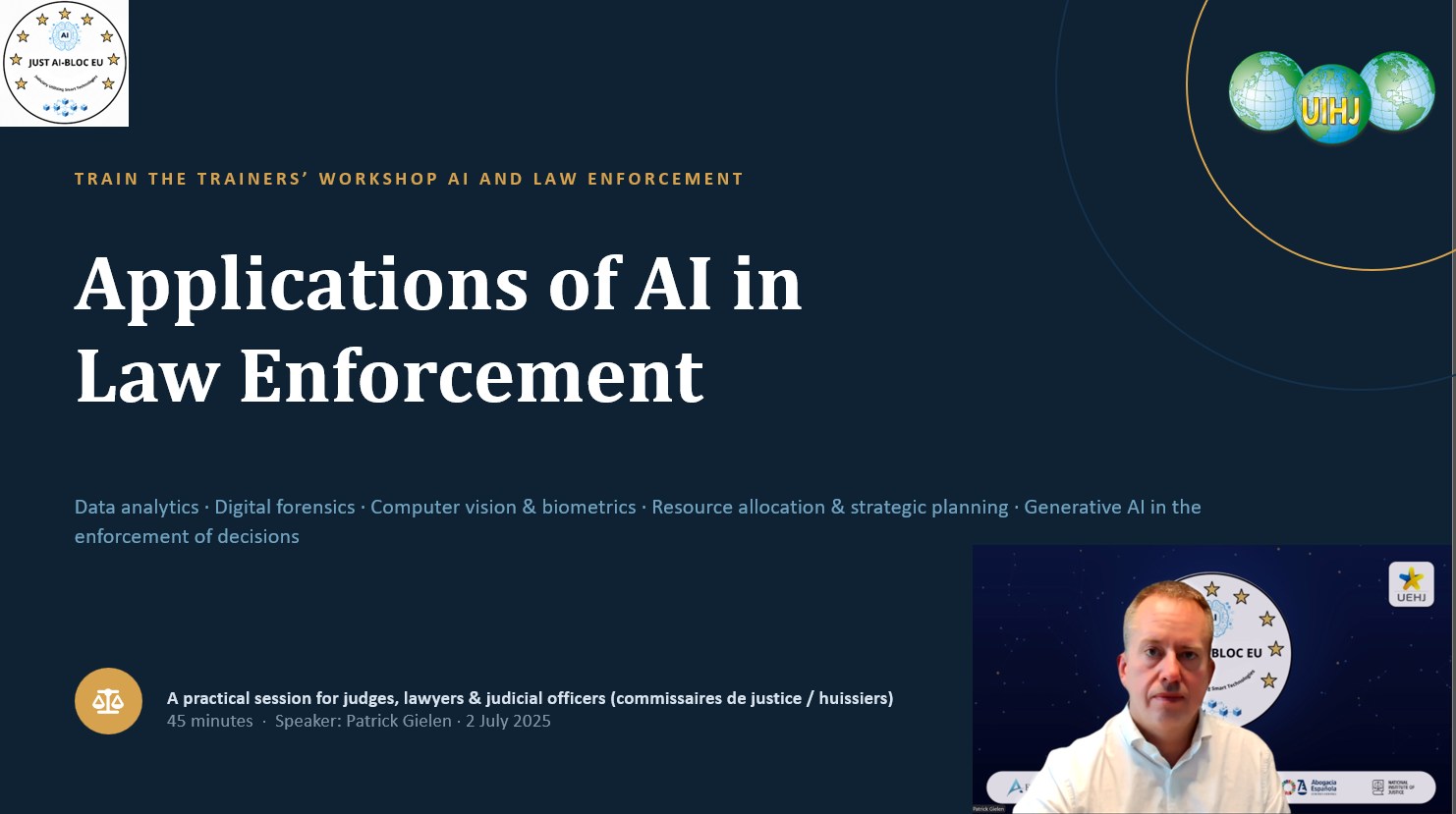
Jos Uitdehaag and Patrick Gielen, both experts and respectively First Vice-President and Secretary General of the UIHJ, took an active part in this workshop. Patrick Gielen presented the practical applications of artificial intelligence in enforcement, ranging from data analytics for asset tracing to digital forensics and the tracing of crypto-assets, computer vision for the inventory of seized goods, resource optimization and generative artificial intelligence in the drafting of enforcement documents. His central message was that the human professional must remain in command of the decision, drawing in particular on the case law of the Court of Justice of the European Union, the CEPEJ Ethical Charter and the principles of the European Law Institute. Jos Uitdehaag then addressed the ethical and social issues raised by artificial intelligence, covering data bias and fairness, privacy and surveillance, accountability and transparency, and human rights and non-discrimination, illustrated by landmark cases in Europe and beyond.
The afternoon took a decidedly practical turn under the guidance of Professor Nadia Rusinova, who devoted her session to training techniques for complex legal topics. She shared best practices in learning and curriculum design, together with methods for making demanding legal and technical subjects accessible to varied audiences, before opening a lively forum for exchanges among the participants. The day concluded with an interactive exercise in which participants designed their own mini training modules, which were then presented and discussed collectively. The future trainers thus leave not only with solid content on artificial intelligence and enforcement, but also with the pedagogical tools they need to pass on this knowledge effectively in their respective countries.