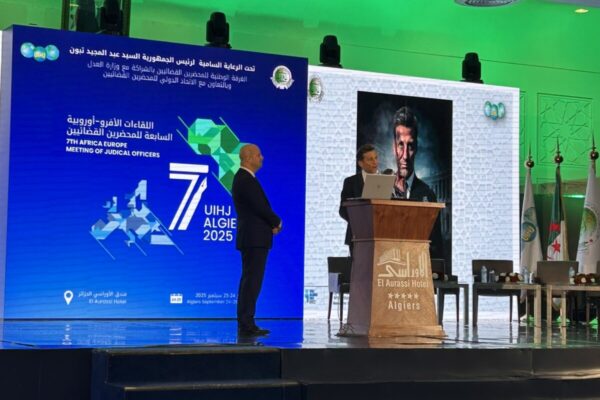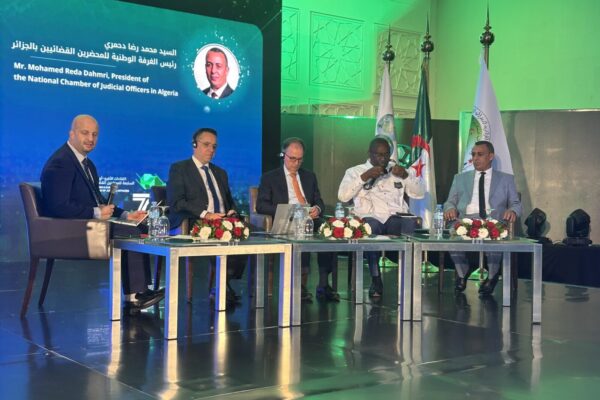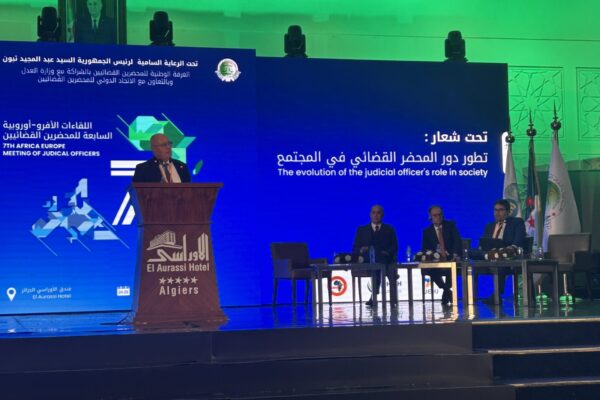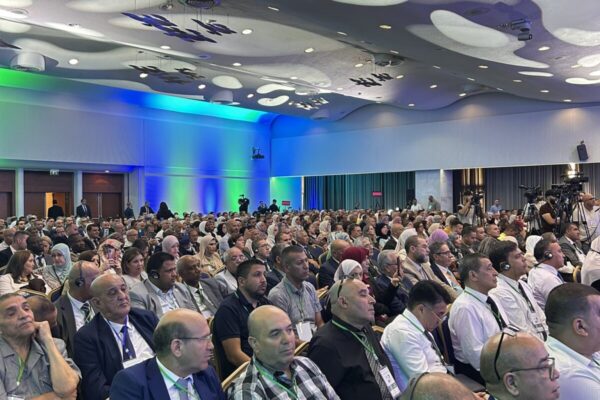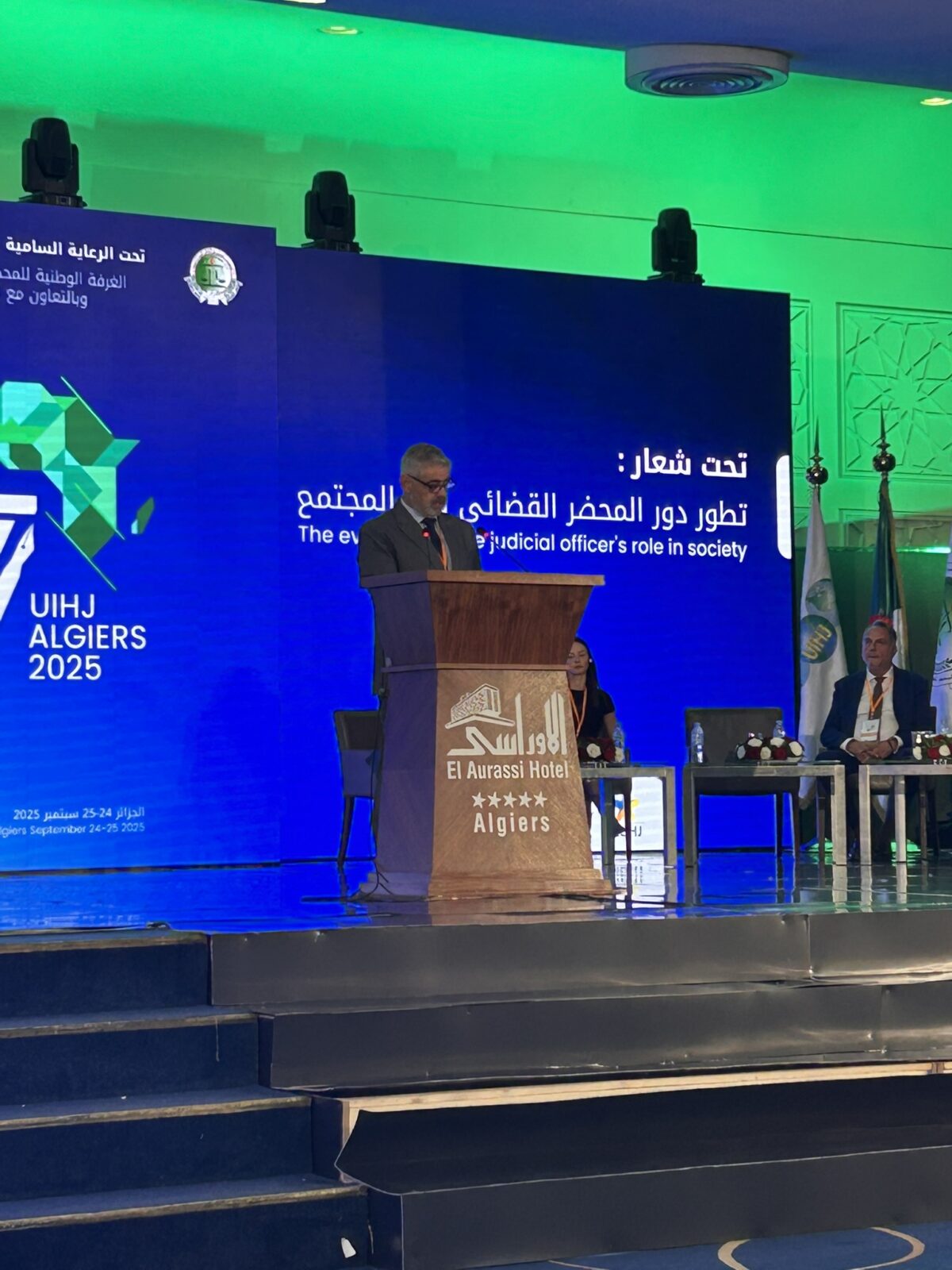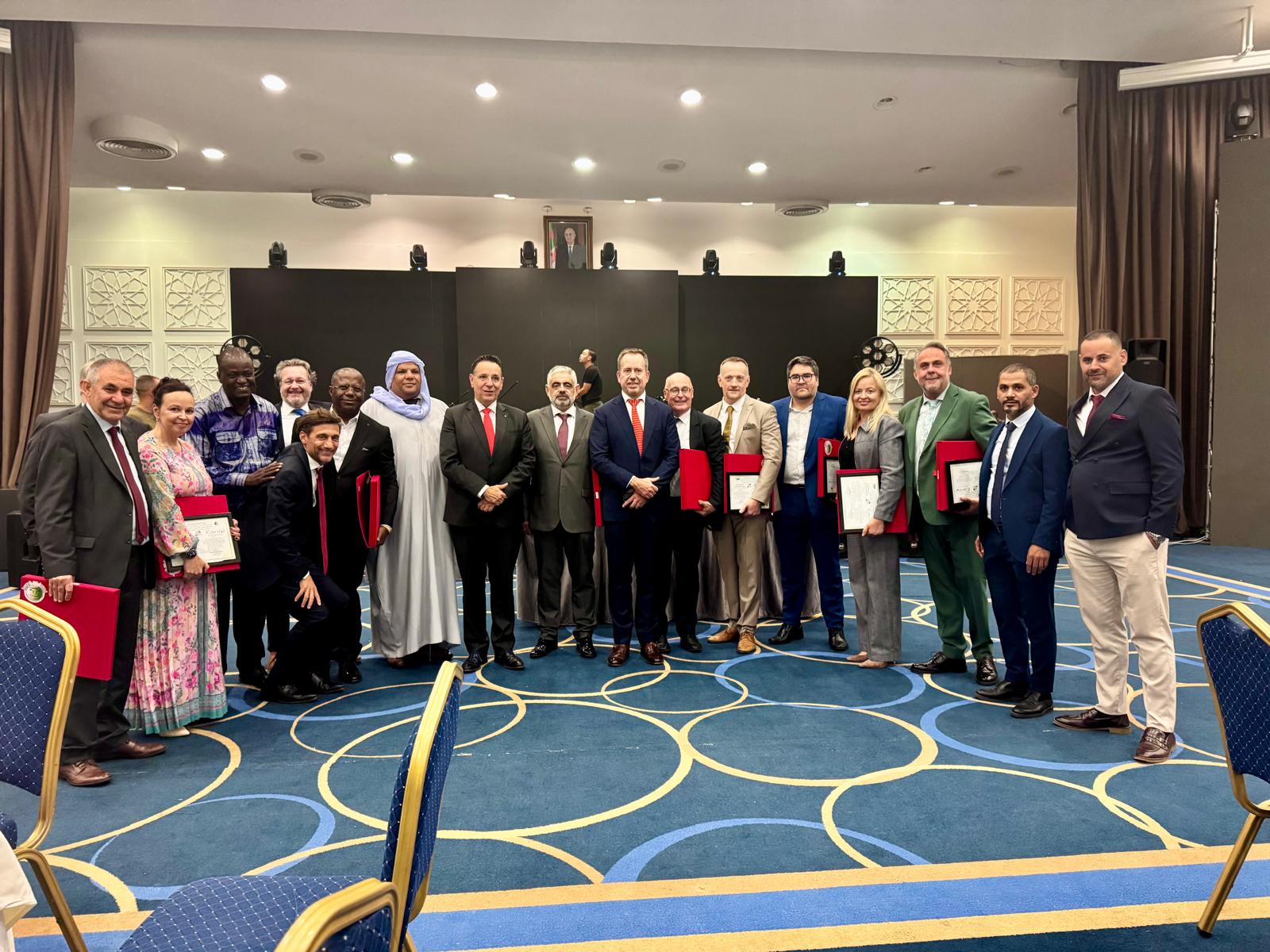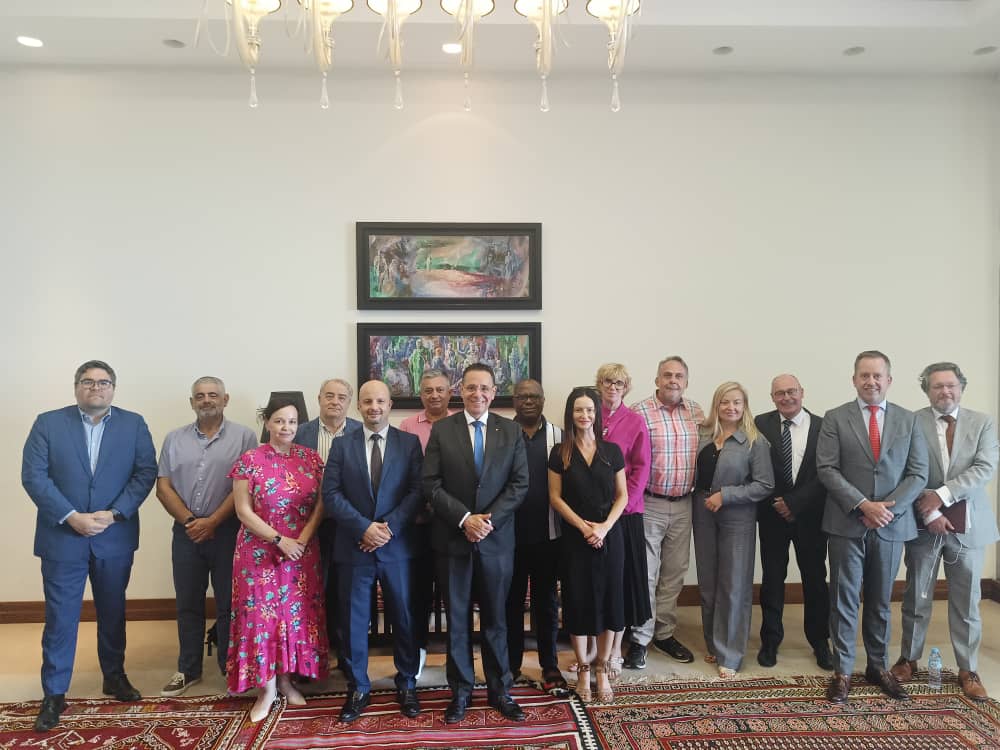

The members of the UIHJ board and the UEHJ executive committee took part in the 7th Africa–Europe Meeting held in Algiers from 23 to 26 September 2025. These meetings were preceded by a joint session of the UIHJ board and the UEHJ executive committee to prepare for the last quarter of 2025 and the major events ahead.
The theme — “The evolution of the role of judicial officers in society” — offered a unique opportunity to reflect on the social and human mission of our profession, particularly in the context of digitalisation and the emergence of Artificial Intelligence in the judiciary.
The Africa–Europe Meetings, organised on 24 and 25 September, brought together more than 1,000 participants from nearly 35 countries. They were held in the presence of Mr Lotfi Boudjemaa, Minister of Justice, Keeper of the Seals of the People’s Democratic Republic of Algeria, and under the high patronage of His Excellency Mr Abdelmadjid Tebboune, President of the People’s Democratic Republic of Algeria, a clear testimony to the institutional importance accorded to the profession of judicial officer.
Explore, Connect, Anticipate
The opening ceremony at the El Aurassi Hotel set the tone. Mr Mohammed Ridha Dahmri, President of the National Chamber of Judicial Officers of Algeria, welcomed the delegations and underlined the significance of this event for Africa and Europe. Mrs Rosine Bogoré Zongo, President of the African Union of Judicial Officers, recalled the founding role of Algeria in structuring the African network and called for continuous training adapted to digital developments.
Marc Schmitz, President of the UIHJ, placed these meetings in the continuity of more than fifteen years of dialogue. According to him, today the judicial officer is a guarantor of legal certainty, a trusted third party, and a multidisciplinary actor facing the digital revolution and social changes. The Algerian Minister of Justice, Mr Lotfi Boudjemaa, emphasised the social and international dimension of the profession and the importance of adapting its missions to societal transformations.
The rest of the day made it possible to explore social changes and their impact on the profession, the legal challenges of globalisation, and the importance of stronger cooperation with the Hague Conference. Contributions from Europe and Africa highlighted the parallel evolution of the profession on both continents and the emergence of new tasks, particularly in mediation, conciliation, and electoral supervision.
The first day ended with a shared conviction: the profession stands at a crossroads. It must anticipate change, diversify its missions, and strengthen its role as a social regulator and prevention actor.
Towards a modernised and harmonised profession
The second day opened up new perspectives around the question “What future for judicial officers?”. Discussions recalled that the judicial officer is not merely an executor but a social and institutional actor whose role must be reconsidered in the light of technological change and the internationalisation of law.
Marc Schmitz identified three priorities: adaptation to new technologies, internationalisation of practices, and the construction of a global legal space. Christophe Bernasconi, Secretary General of the Hague Conference, emphasised the decisive role of international conventions in linking legal systems while respecting their diversity. Samuel Ename underlined Africa’s dynamism, marked by regional integrations and digitalisation, which calls for stronger cooperation with Europe. Finally, Mr Dahmri showed that the Algerian judicial officer is destined to become a true multidisciplinary actor, involved in mediation and dispute prevention.
The debate on harmonisation of practices between Africa and Europe highlighted convergence on key principles and persisting differences linked to the use of digital tools. Rigobert Ndalou and Oscar Jans stressed three essential levers: training, ethics, and technological innovation.
The panel on new technologies illustrated disparities between countries. While Belgium and Lithuania showed how digitalisation and artificial intelligence can strengthen efficiency and transparency, Algeria recalled the need for material investments and a clear legal framework to support modernisation. However, all agreed that technology must remain at the service of human contact, irreplaceable in the mission of the judicial officer.
The session dedicated to governance and ethics highlighted the importance of ethical rules and disciplinary mechanisms in guaranteeing trust and credibility. Transparency, impartiality, and respect for professional secrecy appear as essential conditions.
The afternoon was devoted to training and certification. Prosecutor General Bendoudiaf Mohamed El Kamel recalled that rigorous initial and continuing training is the key to the profession’s adaptation and competence. The Senegalese, French, and Algerian experiences confirmed this need, stressing that the success of de-judicialisation and the integration of new technologies depend on constant skills development.
In conclusion, the second day reaffirmed that trust, modernisation, and human values are the three pillars of the future. The debates showed that harmonisation, governance, and training are levers for building a stronger and more legitimate profession at the heart of modern justice.
In this context, the President of the UIHJ, Marc Schmitz, had the honour of participating in a live television programme on Algerian national TV dedicated to the 7th Africa–Europe Meeting of Judicial Officers. This fifty-minute broadcast provided an opportunity to present the objectives of the meeting, to highlight Algeria’s central role within the UIHJ, and to underline its strong commitment to justice and international cooperation.
In addition, a press conference was held in Algiers on the occasion of these meetings. It was an excellent opportunity to present the UIHJ’s vision, recall the objectives of the conference, and emphasise the essential role of judicial officers in a society undergoing profound change.
Recommendations
At the end of the work, the participants adopted five major recommendations:
- To create an Africa–Europe digital platform dedicated to judicial officers to strengthen interoperability of procedures and facilitate cooperation between professionals through a common space for sharing practices, cross-training, and operational tools.
- To initiate a process of convergence of training and certification standards, with the objective of mutual recognition of skills and the integration of new technologies, mediation, and ethical requirements.
- To strengthen the role of judicial officers in amicable dispute resolution, to meet the growing need for rapid and less adversarial access to justice.
- To reaffirm the legitimacy of the judicial officer as a central actor of modern justice, a trusted third party and guarantor of rights, by enhancing his or her hybrid skills and increasing institutional visibility.
- To promote the adoption and application of Hague Conventions, in particular the 1965 Convention on the Service of Documents and the 2019 Convention on the Recognition and Enforcement of Judgments, to strengthen the effectiveness of international cooperation.
Conclusion
These 7th Africa–Europe Meetings were a scientific, professional, and institutional success. They demonstrated the common will of African and European judicial officers to build a shared future based on innovation, cooperation, and ethics. They open a new stage in intercontinental dialogue and prepare the profession to face the challenges of digitalization and de-judicialization.
The UIHJ wishes to express its deep gratitude to the National Chamber of Judicial Officers of Algeria and its President, Mr Mohammed Ridha Dahmri, as well as to Mr Mohamed Reda Bougrine, for their constant commitment and decisive role in the success of these historic days.