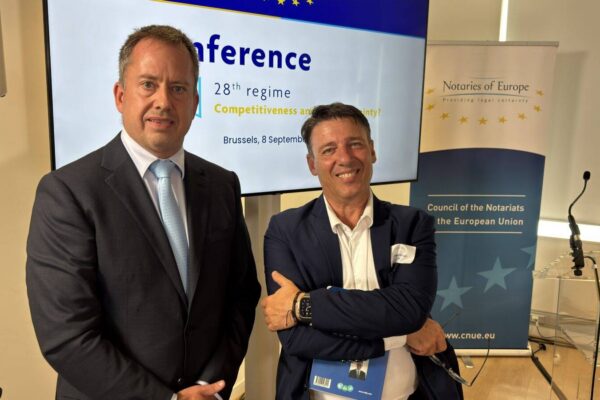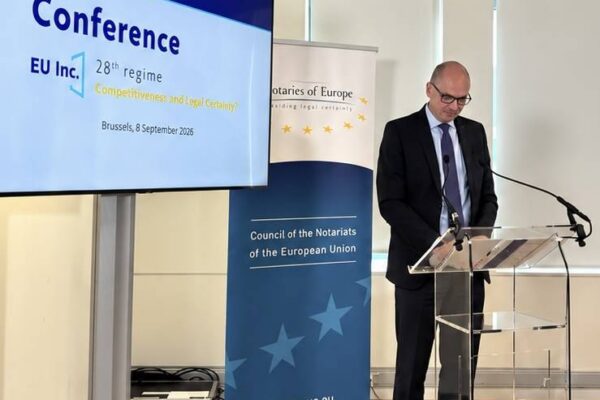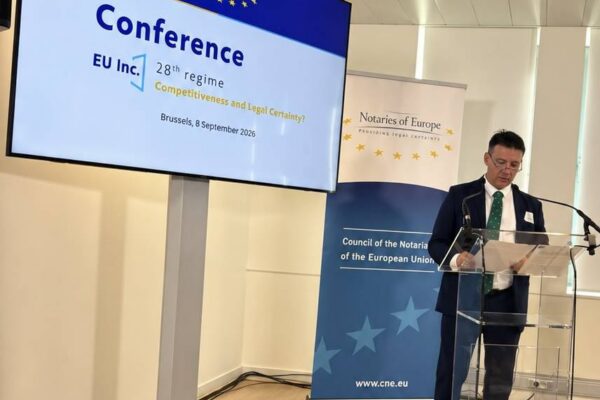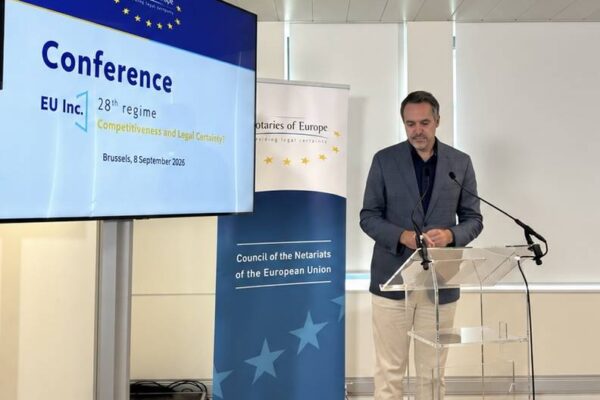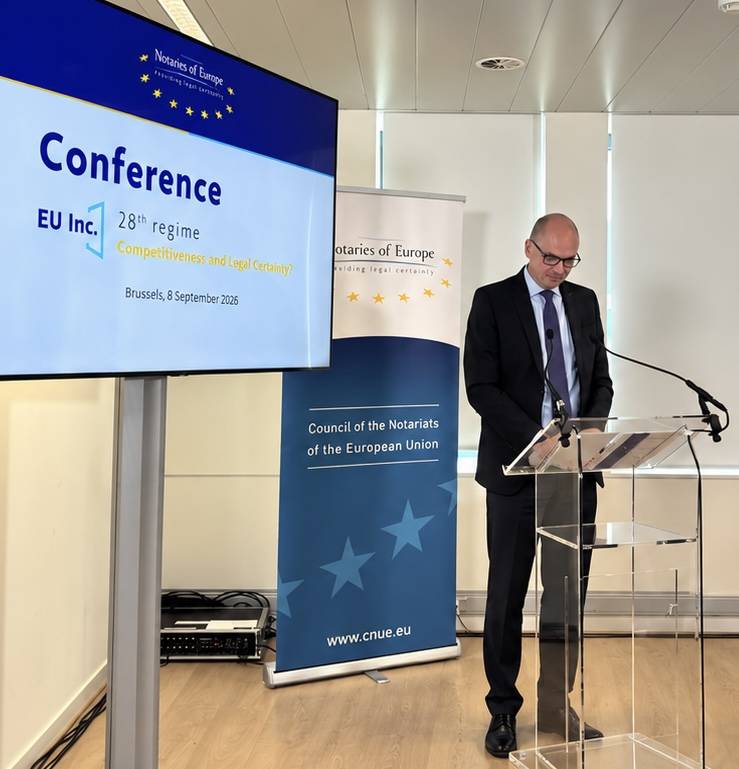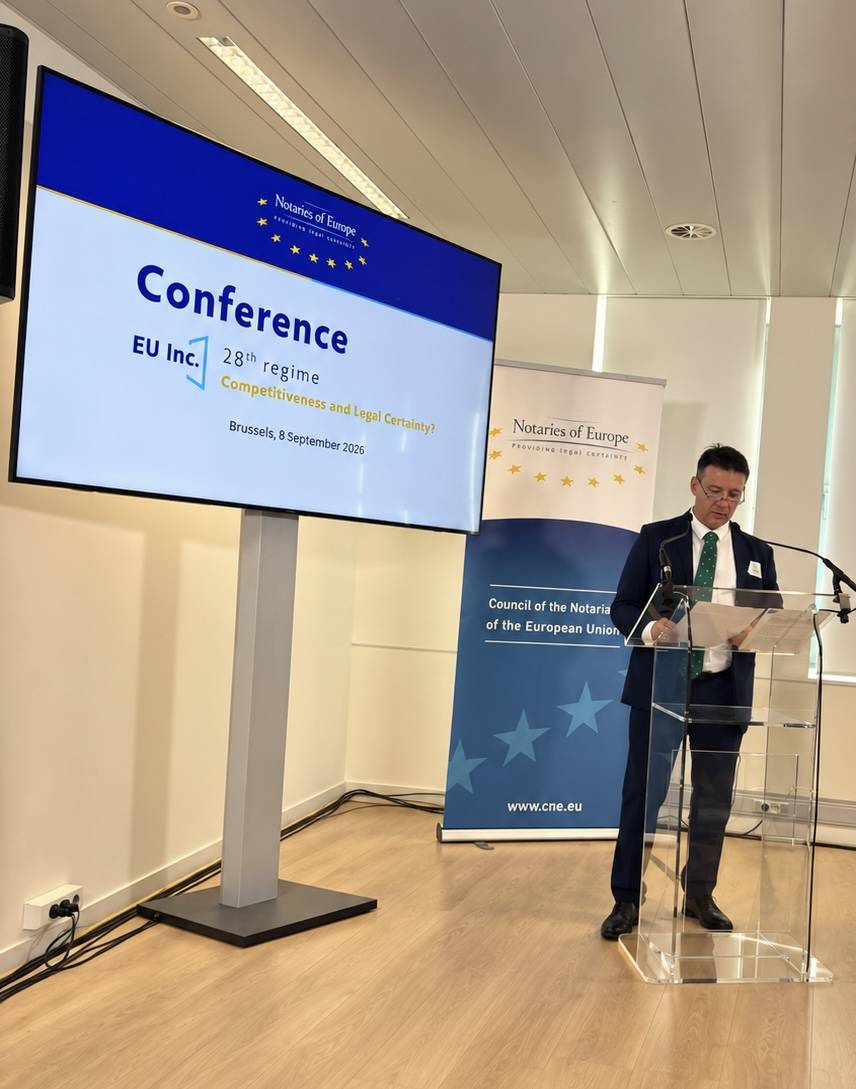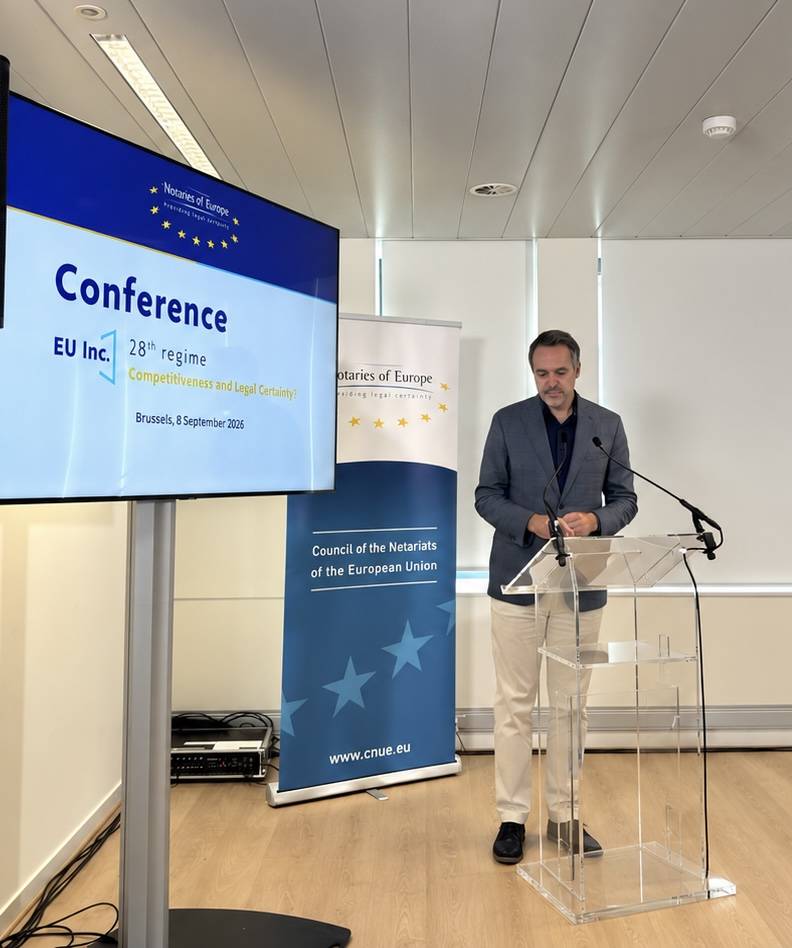
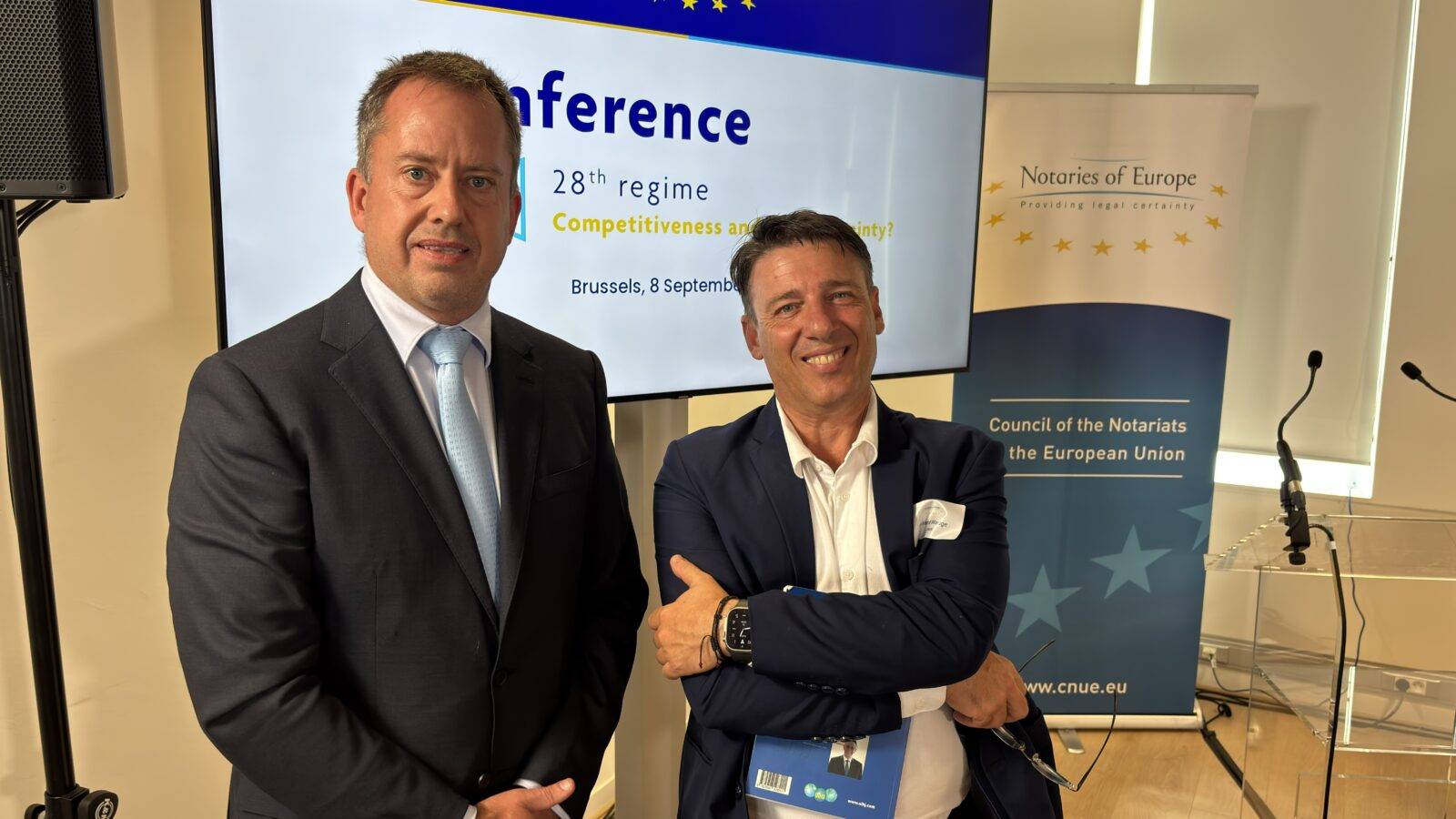
The European Union of Judicial Officers (UEHJ) participated in Brussels in the conference organised by the Council of the Notariats of the European Union (CNUE) on “EU Inc. – the 28th Regime: Competitiveness and Legal Certainty?”. The UEHJ was represented by Patrick Gielen, Secretary General of the UIHJ.
Opened by Roland Wadge, President of the CNUE, the conference brought together representatives of the European institutions and legal professions. Hubert Gambs, Acting Director-General of DG JUST at the European Commission, presented the Commission’s perspective on EU Inc., while MEP René Repasi addressed the 28th Regime from the European Parliament’s perspective. The programme also provided an opportunity for economic and legal stakeholders to exchange views on the proposal.
EU Inc. pursues a useful and necessary objective: providing companies, particularly start-ups and scale-ups, with a common, simpler, digital and efficient European framework facilitating their creation, growth and investment across the Single Market. The proposal notably provides for a new harmonised company form and extensively digitalised procedures.
However, simplification cannot come at the expense of legal certainty, creditor protection and effective enforcement. This is the central message of the UEHJ Position Paper published in June 2026. While recognising important positive elements, including BRIS interconnection and electronic auctions, the UEHJ identifies several significant risks for enforcement.
In particular, the UEHJ highlights the reduction of preventive controls and legal formalities, insufficient safeguards regarding minimum capital, certain rules on share transfers, and simplified liquidation and insolvency procedures. These elements may make it more difficult to identify debtors and their assets and may facilitate asset transfers that are difficult to trace, with potentially negative consequences for enforcement and debt recovery.
For the UEHJ, the success of EU Inc. will also depend on creditor confidence. A judicial decision cannot remain a theoretical right: it must be effectively enforceable. The future instrument must therefore strike the right balance between administrative simplification, digital innovation, legal certainty, creditor protection and respect for the Rule of Law.
The conference demonstrated the importance of dialogue between the legal professions. By working together, particularly with European notaries, we can contribute to developing this proposal into a competitive and modern European instrument that also provides legal certainty and effective enforcement.
The UEHJ warmly thanks the CNUE and its President Roland Wadge for the invitation and for these valuable exchanges.