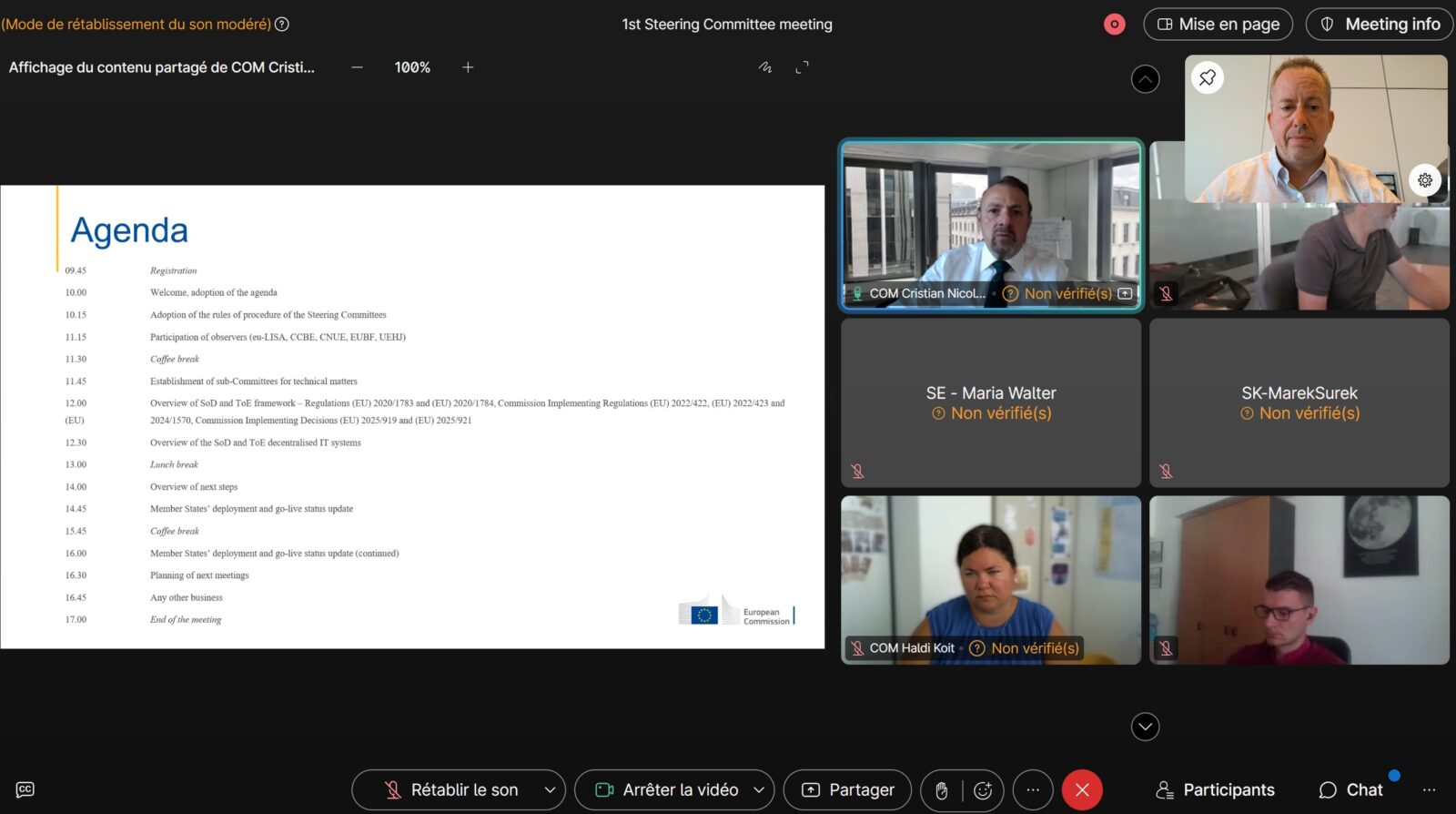

On 2 July 2025, the first joint meeting of the steering committees established under Regulation (EU) 2020/1784 of the European Parliament and of the Council of 25 November 2020 on the service in the Member States of judicial and extrajudicial documents in civil or commercial matters (recast) and Regulation (EU) 2020/1783 of the European Parliament and of the Council of 25 November 2020 on cooperation between the courts of the Member States in the taking of evidence in civil or commercial matters (recast) was held online.
The meeting opened with the formal adoption of the agenda and of the rules of procedure, based respectively on Commission Implementing Decision (EU) 2025/921 establishing the Service of Documents Steering Committee, and Commission Implementing Decision (EU) 2025/919 establishing the Taking of Evidence Steering Committee. These rules provide the framework for the organisation and functioning of both bodies, including the conditions for decision-making, the role of observers, and the possibility to establish sub-committees.
The steering committees officially welcomed the participation of observers, including eu-LISA, the Council of Bars and Law Societies of Europe (CCBE), the Council of the Notariats of the European Union (CNUE), the European Union of Judicial Officers (UEHJ), and the European Union of Judicial Officers’ Foundation (EUBF).
A key point on the agenda was the establishment of technical sub-committees, aimed at supporting the implementation of the regulations and addressing practical and IT-related issues. The committees also reviewed the legal and operational framework, including Commission Implementing Regulations (EU) 2022/422, (EU) 2022/423, and (EU) 2024/1570, which provide technical specifications and operational rules for the secure and decentralized digital transmission systems.
In the afternoon, Member States provided a status update on the national deployment and go-live planning of the respective IT systems. The meeting concluded with a discussion on next steps and the schedule of future meetings.
This first joint session confirmed the importance of coordinated efforts and continuous dialogue among EU institutions, Member States, and professional stakeholders in ensuring the successful digitalization of cross-border civil justice in the EU.